
Menu
Rev. Moon graduated from high school in 1941 and traveled to Japan to pursue electrical engineering at a technical college linked to Waseda University. While there, he maintained his fervent spiritual practice, immersing himself in prayer and the search for divine truth. A classmate recalled that Moon kept three Bibles in his room—Korean, English, and Japanese—studying them diligently to deepen his understanding.
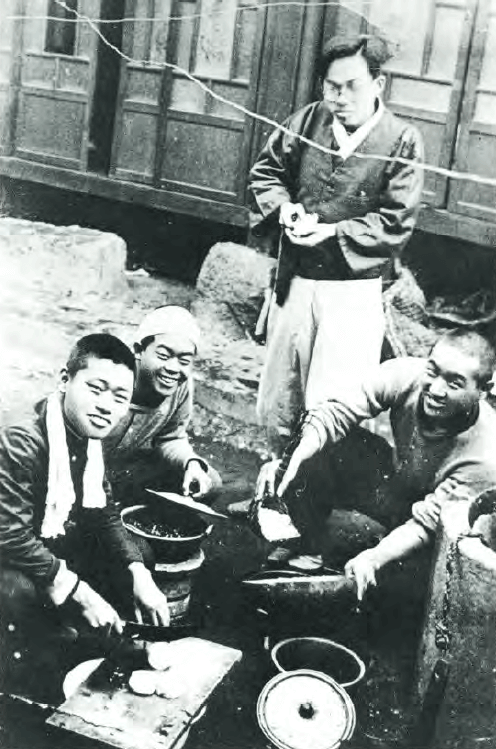
Sun Myung Moon tirelessly explored the Bible and various religious texts to uncover the deeper meaning of human history. In this period, he engaged in profound communion with God, navigating the intense struggle between spirit and flesh. He completely renounced personal ambitions and completely devoted himself. He came to comprehend God's own anguish and His yearning to reconnect with His children. Moon realized the challenging path humanity must follow to return to God and achieve lasting peace on earth. He understood that success in his mission required a deep knowledge of the Creator and His creation.
He intensified his pursuit of truth, dedicating days and nights to fervent prayer, strict fasting, and study. His approach involved posing precise questions, investigating answers in both the physical and spiritual realms, and seeking validation through prayer. On multiple occasions, he received direct guidance from Abraham, Moses, Jesus, and other holy figures of diverse faiths, who met him in spirit and enriched his understanding of God and the intricate history of God's relationship with humanity. By age 25, he had formulated the core principles of his foundational teaching, the Divine Principle.
Rev. Moon also emerged as a Christian leader in the Korean independence movement, resisting Japan’s colonial rule over Korea. During this period, young Christians and communists were at the forefront of the fight for liberation. Despite his discomfort with the atheism of some communist schoolmates, Moon respected their genuine commitment to a utopian vision. A fellow student, Aum Duk-Moon, noted that Moon defended these communists to his Christian peers, urging Koreans to unite for their nation’s freedom. After returning to Korea, Rev. Moon was arrested and severely tortured by the Japanese occupation government in Korea after his name came up in the interrogation of a communist student friend who had participated in the anti-Japanese underground in Tokyo. He refused to confess and was finally released.
In spite of such treatment by the Japanese, Rev. Moon showed only love and respect to the Japanese people. When the war ended in August 1945, he convinced others not to take revenge on local Japanese officials and worked secretly to help them safely return to Japan.